
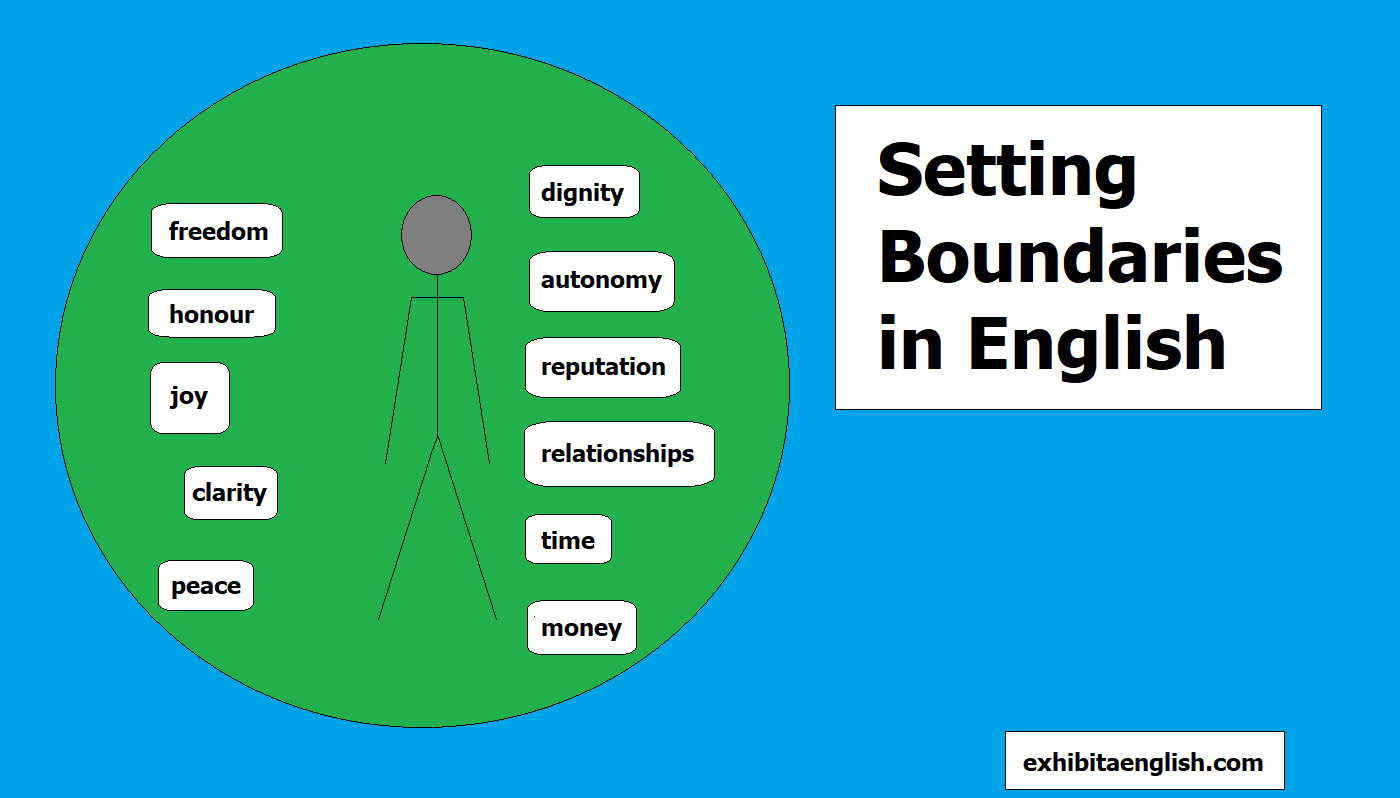
Let’s talk about setting personal boundaries.
1.) What are your pet peeves?
2.) What is a deal breaker in a friendship for you?
3.) What’s the difference between social norms and boundaries?
4.) What aspects of your life do you set boundaries around?
5.) What treatment do you not accept from anyone, ever?
6.) How willing are you to behave unethically in order to benefit your family?
7.) Talk about a time that you had to set a limit with someone. How did they react?
8.) Talk about a time that someone set a limit on your behavior. How did you react?
VOCABULARY
Feelings and Emotions – Identify your feelings with more precision.
Vocabulary Booster – Try the advanced quiz to learn words related to borders, boundaries, and limits.
Idioms of Place and Location – Do you go over and above for others? Do you find you have to set boundaries with someone over and over again? Learn some useful idioms!
AN EXAMPLE OF BOUNDARIES IN ENGLISH
Read each slide. Use your own words to summarize the ideas. Think of a light example of a similar situation to use as a case study.
READING – PERSONAL BOUNDARIES
What are personal boundaries?
For the most part, the way we treat each other is dictated by social norms and convention. We share common ideas about how we interact, and we don’t need to think about it much. When shared ideas of common decency fail, we have systems of laws and enforcement that we can turn to.
Personal boundaries are a little different, because they are set individually by each person. They are the limits we each set around the behaviour we are willing to tolerate from others. Our boundaries are nuanced and they change over time. They require us to know ourselves well and to be able to communicate clearly with those around us.

Why is having boundaries important?
Everyone of us experiences life from our own point of view, and we’re each going to have different levels of tolerance for different behaviours. What is okay with other people may not sit right with someone else.
Your boundaries are your social, spiritual body. They give you the room you need to live authentically, based on your core values. They set clear, fair, well-thought out ways that you want to walk around in the world and what is okay with you.
Without boundaries, you are at the whim of others. The way they treat you isn’t up to you. You hope they treat you kindly, and do what you can to encourage them to like you and treat you the way you’d like. And it probably doesn’t work very well.
Who are you? Where do others stop and you begin? What are your contours? Knowing ourselves is the most brave, honourable, and loving thing any of us can do. Butting up against each other helps us know ourselves and each other.
And it all starts with you.
How can I get started setting healthy boundary?
Setting boundaries involves a lot of work ‘behind the scenes’. It requires us to think differently about ourselves and our social interactions. Approach it with a sense of curiosity. Ask yourself questions and take the time to listen to the answer.
Here are some questions you might ask yourself, when you notice that you are tolerating a behaviour that feels wrong or causes you damage:
1.) How do I feel when I am treated in this way?
2.) What is the exact behaviour that feels like a violation?
3.) Do I have a right to refuse to accept the behaviour?
4.) What do I want my boundary to be, in terms of the behaviour?
5.) Are there situations or exceptions where I would be willing to tolerate the behaviour?
6.) How can I best communicate the boundary? What words do I want to use?
7.) How do I intend to defend the boundary? What are the consequences of violating it?
8.) How and when do I want to have the first conversation about my boundaries?
9.) How will I stay calm and centered if the person refuses to respect my boundary?
10.) What will I do if the person wants to have an argument with me about it?
Practice, practice, practice.
There’s no rush. Your boundaries grow as you do. It happens naturally and gradually. Once you have thought it all through, it’s time to start putting it into practice, gently, yet firmly and consistently. Pick your battles. Start small. Practice and learn from your mistakes.
Don’t be too hard on yourself if you don’t nail it every time. Like any new skill, it takes practice. What matters is that you are thoughtful and intentional, and keep working on it. There will be some bumps along the way, but it’s a worthwhile journey, and it starts with you.
SPEAKING AND CONVERSATION
1.) Each speaker thinks of a real or hypothetical behaviour that you want to use as an example, and takes turns asking the questions above.
2.) Let’s do some role plays, so you can get the hang of it and try out different approaches to boundary setting with WIN role plays.
3.) See more conversation questions!
READING
General reading:
Personal Boundaries – Wikipedia
The Hard Truth About Boundaries and Selfcare – Forbes
Read about how therapy terms are misused in English:
‘Therapy Speak’: Is it Healthy or Is it Being Weaponized? – Mindbodygreen
How Abusers Hijack your Healing Language – Therapytips.org
Read about how setting boundaries protects against manipulation:
3 Ways You Unknowingly Invite Psychological Control – Therapytips.org
LISTENING
5 Reasons to Set Healthy Boundaries with Toxic People – iSL Collective
SPEAKING
Quotes Speaking Activity
Select a quote and share your thoughts.
1.) Teasing a person is to hide your weakness and betraying a person is to hide his strength.
– P.S. Jagadeesh Kumar
2.) Speak softly and carry a bit stick.
– President Theodore Roosevelt
WHAT DO YOU WANT TO PRACTICE NEXT?
Other topics you might enjoy…


